||
- Existing Parent PLUS borrowers must consolidate and enroll in income-driven repayment by strict 2026 deadlines to preserve access to forgiveness.
- Borrowing a new Parent PLUS loan after July 1, 2026 will permanently eliminate eligibility for income-driven repayment and PSLF, even if older loans were properly consolidated.
- New Parent PLUS loans issued after July 1, 2026 will be capped and limited to standard repayment only.
Parents who borrowed to help pay for their child’s college through the federal Parent PLUS Loan program face a narrow set of deadlines in 2026 that could permanently shape their repayment options. The year marks a sharp divide between borrowers who already hold Parent PLUS loans and those who borrow for the first time after July 1, 2026.
For existing borrowers, 2026 offers a final opportunity to access income-driven repayment and Public Service Loan Forgiveness (PSLF). For new borrowers, the rules tighten significantly, with borrowing caps and standard repayment becoming the default (and only) option.
Here are the takeaways families should understand before making decisions that cannot be undone.

Existing Parent PLUS Loan Borrowers: Take Action By March
Parents who already have Parent PLUS loans can still gain access to income-based repayment (IBR) and PSLF - but only if they act on time and follow the correct sequence.
Under current rules, Parent PLUS loans are not eligible for income-driven repayment on their own. The only way in is through federal Direct Loan consolidation.
To preserve access to IBR and PSLF, existing Parent PLUS borrowers must complete consolidation by June 30, 2026, then enroll in the Income-Contingent Repayment (ICR) plan. After making one qualifying ICR payment, borrowers may then switch into IBR.
However, consolidation takes time. The Department of Education has provided guidelines that encourages parents to consolidate their loans at least three months before that deadline. That means you should start the consolidation process by March 30, 2026.
This process matters because PSLF eligibility requires qualifying payments made under an income-driven plan while working for a qualifying employer. Without consolidation and enrollment in ICR first, Parent PLUS borrowers cannot earn PSLF credit moving forward.
If consolidation is not completed by June 30, 2026, Parent PLUS borrowers lose access to income-driven repayment entirely. At that point, standard repayment becomes the only option, eliminating any pathway to PSLF or income-based forgiveness.
Existing Parent PLUS Borrowers: Grandfather Clause With Limits
Existing borrowers are covered by a grandfather clause that allows them to continue borrowing uncapped Parent PLUS loans for up to three additional academic years, or until the child completes their degree program—whichever comes first.
But this rule in the 2026 timeline is especially consequential—and often misunderstood.
If an existing Parent PLUS borrower takes out a new Parent PLUS loan after July 1, 2026, they lose access to income-driven repayment and PSLF.
In practical terms, that means a parent who carefully consolidated older loans, enrolled in ICR, and switched into IBR could see all of that progress erased by borrowing a new Parent PLUS loan later. The result would be permanent placement into standard repayment, with no loan forgiveness options, even for loans that were previously consolidated correctly.
The grandfather clause applies only to borrowing limits. It does not preserve access to income-driven repayment if a parent borrows again after July 1, 2026.
First Time Parent PLUS Loan Borrowers: Restrictions Start July 1, 2026
For parents who borrow for the first time after July 1, 2026, the program looks very different.
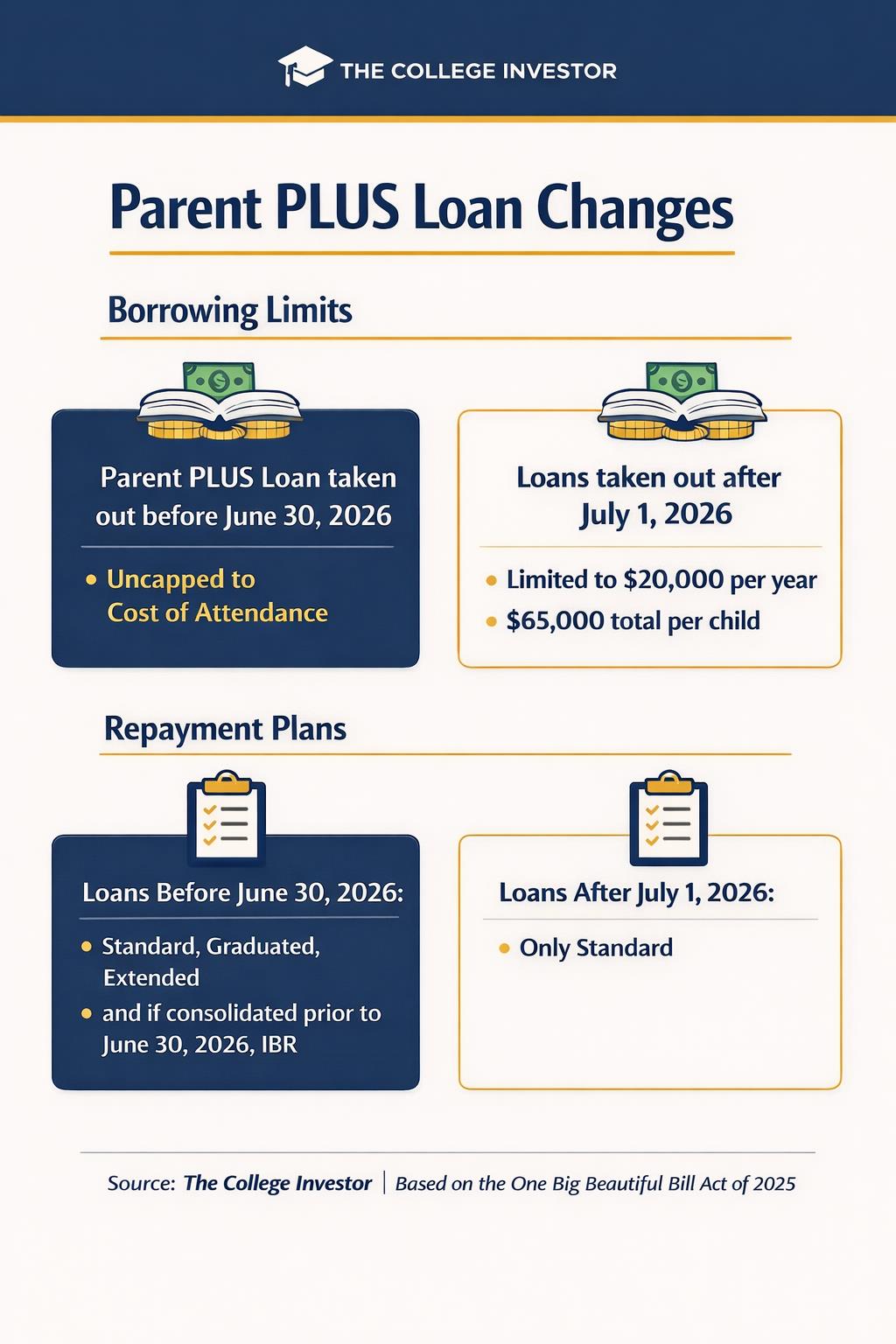
New Parent PLUS loans will be subject to strict borrowing limits:
- Up to $20,000 per year per child
- A $65,000 lifetime cap per child
Just as important, these new loans will only be eligible for standard repayment. Income-driven plans (including ICR and IBR) will not be available, and PSLF will not be an option.
Historically, Parent PLUS loans allowed parents to borrow up to the full cost of attendance, minus other aid. Beginning July 1, 2026, borrowing is capped, and repayment flexibility is sharply reduced.
Families relying on Parent PLUS loans to bridge large gaps in college costs may need to reassess financing plans, especially for multi-year programs or higher-cost institutions.
What This Means For Families Right Now
For parents with existing Parent PLUS loans, 2026 is less about choice and more about timing. Missing consolidation deadlines or borrowing again at the wrong moment can remove forgiveness options for the life of the loan.
Parents considering additional borrowing beyond the student's federal loan should weigh alternatives, including tuition payment plans or private student loans.
For families planning future college enrollment, the new caps and repayment limits after July 1, 2026 may require revisiting college choices altogether.
Don't Miss These Other Stories:
What’s Changing For Student Loans In 2026?
What’s Changing For Student Loans In 2026?
Standard Plans Stay For Current Student Loan Borrowers
Standard Plans Stay For Current Student Loan Borrowers
10 Biggest FAFSA Mistakes That Could Cost You Financial Aid
10 Biggest FAFSA Mistakes That Could Cost You Financial Aid
The post Parent PLUS Student Loan Timelines In 2026 appeared first on The College Investor.
||
---------------------------
By: Robert Farrington
Title: Parent PLUS Student Loan Timelines In 2026
Sourced From: thecollegeinvestor.com/73260/parent-plus-student-loan-timelines-in-2026/
Published Date: Wed, 14 Jan 2026 11:30:00 +0000
Read More
Did you miss our previous article...
https://peaceofmindinvesting.com/clubs/7-ideas-for-investing-your-tax-refund-to-get-the-most-out-of-it
.png) InvestingStocksToolsClubsVideosPrivacy PolicyTerms And Conditions
InvestingStocksToolsClubsVideosPrivacy PolicyTerms And Conditions