||
- Skilled trades deliver strong pay in a worker's 20s without student debt, but federal data shows the earnings curve flattens while white-collar pay keeps climbing into a worker's 50s and 60s.
- Workers whose longest-held job was in construction trades were 124% more likely to end up on Social Security Disability Insurance than workers in managerial jobs.
- Disability insurance can cover part of that risk, but it typically costs 1% to 3% of income annually, and physically demanding occupations face higher premiums or narrower coverage options.
The pitch for the trades has rarely sounded better. A high school graduate can enter an apprenticeship at 18, get paid while training, and reach a median wage of roughly $62,000 by their mid-20s with no student loan balance attached.
Their college-bound peers, meanwhile, are four years behind on income and carrying the average student loan debt that now follows most graduates into their 30s.
That math is real. The U.S. Department of Labor counts about 480,000 registered construction apprentices, a 28% increase over five years, and electrical apprenticeship applications climbed 70% between 2022 and 2024 to roughly 120,000.
Congress has been building policy around the shift, too — the new Workforce Pell Grant extends federal aid to short-term job training for the first time, and 529 plans now cover trade schools, licenses, and certificate programs. Families are responding to a genuine value proposition.
What the entire premise leaves out is the second-half of the career. You rarely see 65-year-old electricians pulling wire through an attic in August, or plumbers in their 70s under a house on their knees. You do see 65-year-old managers in the office. That difference isn't a matter of ambition or work ethic. It's a matter of what the job asks of the body, and it belongs in any honest calculation of return on investment between the two paths.
The Earnings Curve
The two paths front-load and back-load income differently, and the shape of each curve matters more than the starting number that dominates most comparisons of trade school and college.
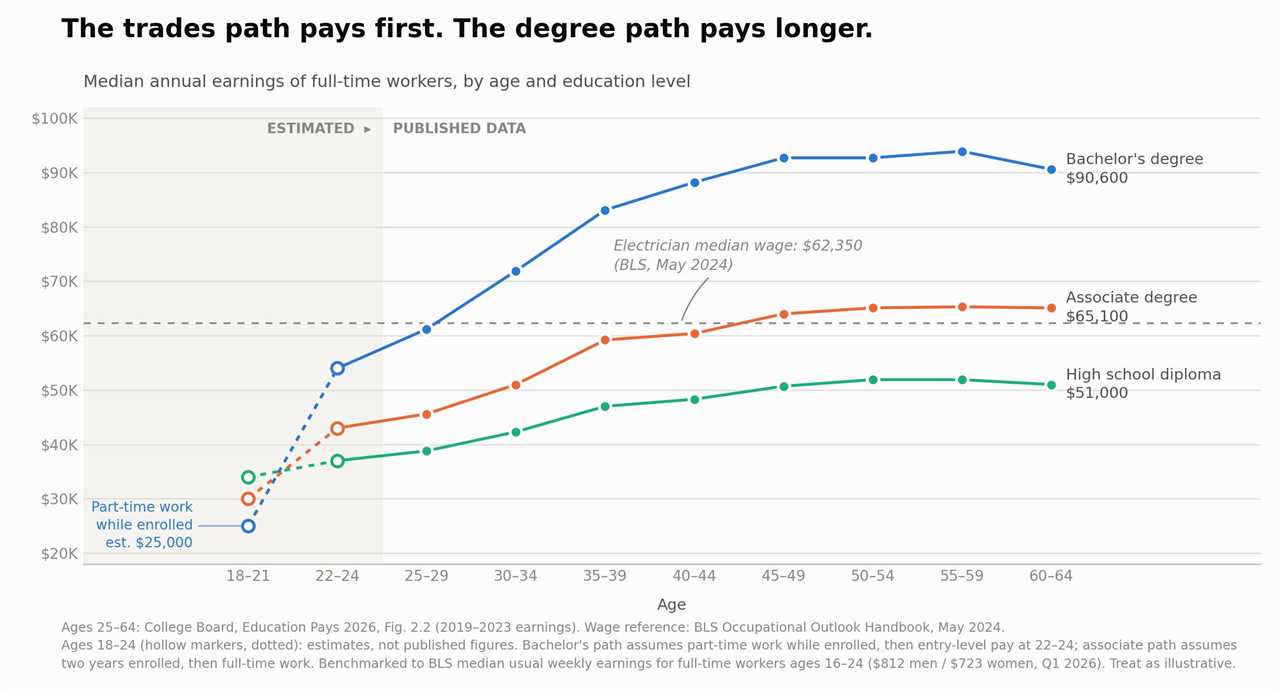
Bureau of Labor Statistics data from May 2024 puts the median annual wage at $62,350 for electricians, $62,970 for plumbers, pipefitters and steamfitters, and $59,810 for HVAC mechanics and installers. All three beat the $49,500 median across all U.S. occupations, and all three land near the top of the jobs that pay well without a degree. A journeyman hits that number early and, absent a move into supervision, contracting or business ownership, tends to stay near it.
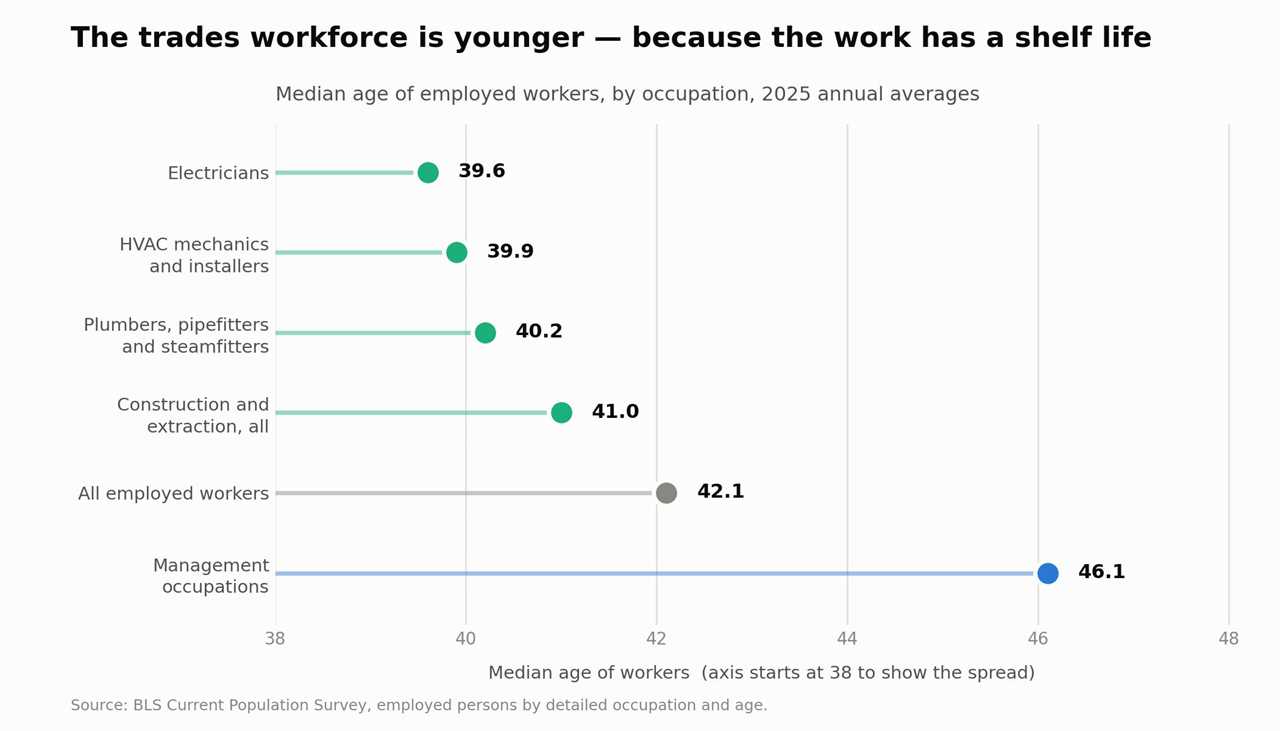
Management occupations show a median hourly wage of $58.70, or roughly $122,000 a year, according to BLS wage statistics. Those medians are pulled upward by workers in their 40s and 50s, and the age data reflects it: the median age in management occupations is 46.1, compared with 39.6 for electricians and 40.2 for plumbers.
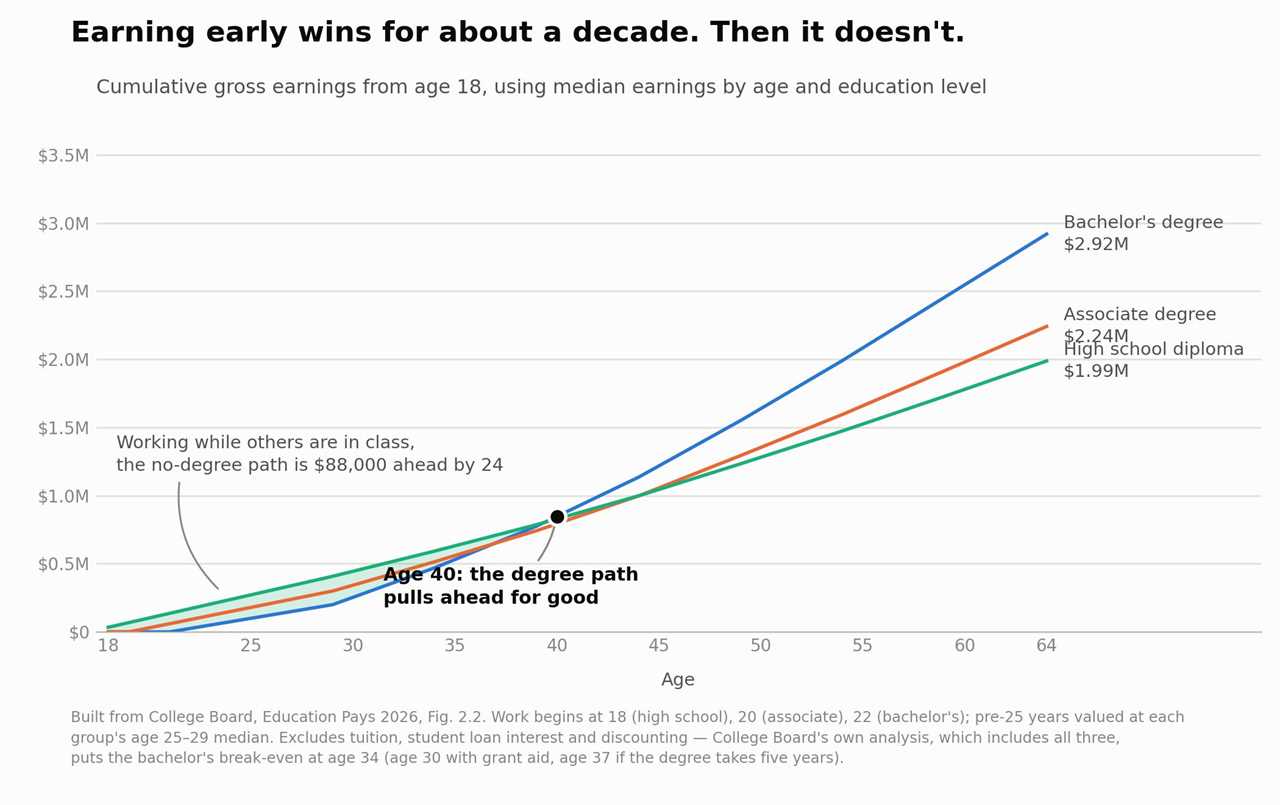
Career trajectory, not starting salary, is what separates the educated-but-not-wealthy from workers who compound their income over four decades.
A 2026 Federal Reserve Bank of Boston working paper studying 45 birth cohorts found that men with sub-baccalaureate education saw largely stagnant earnings growth across cohorts, while advanced degree holders posted the strongest gains.
The paper also found that for less-educated workers, longer working lives (not higher pay) became the main source of late-career earnings growth between ages 45 and 64. That is the quiet problem, and it reframes how much you need to save for anyone on the trades path.
The Human Body Is A Depreciating Asset
The clearest evidence of the shorter runway comes from disability data, which is where the difference between SSDI, SSI and Social Security stops being academic.
A study published in a peer-reviewed journal analyzed 16,196 Health and Retirement Study respondents aged 51 to 64, tracked across 13 survey waves from 1992 to 2016. Using managerial workers as the baseline, it found construction trades and extraction workers had a hazard ratio of 2.24 for receiving Social Security Disability Insurance benefits — 124% higher. Transportation operators came in at 2.07 and mechanics and repair workers at 1.78. Roughly 8% of the full sample went on SSDI during the follow-up period, a reminder that disability discharge of student loans exists precisely because career-ending injuries are common enough to legislate around.
Acute injury risk points the same direction. BLS counted 5,070 fatal work injuries in 2024, a rate of 3.3 per 100,000 full-time equivalent workers, in its Census of Fatal Occupational Injuries.
Construction and extraction occupations accounted for 1,032 of those deaths, including 370 fatal falls. BLS describes HVAC work as having one of the highest rates of injuries and illnesses of all occupations — a risk profile that makes term life insurance a baseline purchase rather than an optional one.
Injuries also cost more as workers age. In a BLS analysis of injury severity by age, injured workers 65 and older missed a median of 18 days, versus 12 days for workers 55 to 64 and 8 days across all ages. Nearly 40% of cases among workers 65 and older involved 31 or more days off.
The frequency of injury falls with age, but the cost of each one rises, which is why an emergency fund sized to weeks rather than months is inadequate in this line of work.
Insuring The Risk Costs Money And Lowers Early Returns
Disability insurance is the direct hedge, and it isn't free. Long-term coverage generally runs 1% to 3% of annual income, and premiums rise with occupational risk. Insurance companies price by occupation class, and physically demanding work draws higher rates or limited coverage options, as our guide to disability insurance policies lays out.
The policy definition matters more for trades workers than for anyone else. An "own-occupation" policy pays if you can no longer do your specific job. An "any-occupation" policy pays only if you can't do any work at all. A plumber with a destroyed back may be unable to work as a plumber while remaining physically capable of a desk job, which means an any-occupation policy would likely pay nothing.
Own-occupation coverage costs more, and for someone whose income depends on knees, shoulders and a spine, it is the coverage that matters. Workers' compensation covers on-the-job injuries only, and wear-and-tear accumulated over 25 years usually isn't a compensable claim, so the gap has to be filled with multiple income streams or private coverage.
What This Means For Your Household
The practical question isn't whether the trades are a good career. For many people they clearly are. The question is what a household has to do differently to make the money last as long as the person does, and three structural gaps show up in the data.
The first is retirement savings. Analysis of BLS benefits data shows construction workers have access to a defined contribution plan 68% of the time and participate 45% of the time — the lowest participation among the sectors studied, against 82% in the information sector. A trades worker with a shorter earning window and a lower savings rate is compounding two problems at once, and 401(k) contribution limits only help the people who actually enroll.
The second is that the peak earning years and the peak spending years overlap. Trades income arrives in a worker's 20s and 30s, the same window as first homes, young children and car payments. White-collar income arrives in the 50s, after many of those costs have leveled off, which makes it easier to save. Earning early is an advantage only if the money is captured, which is why the order of operations for funding retirement matters more on this path, not less.
The third is self-employment. Construction has a higher share of self-employed workers than nonfarm industries generally, and self-employment means no employer-paid disability coverage, no employer retirement match, and no paid recovery time. Independent contractors have to build their own benefits stack — self-employed health insurance and a self-employed retirement plan are purchases, not perks.
With all these things in mind, compare cumulative lifetime earnings and benefits, not starting salaries. Debt-free at 22 is a real advantage, but so is a job that still works at 62. A college ROI calculator handles one side of that comparison but the durability of the work is the side nobody models.
Don't Miss These Other Stories:
529 Plan vs. Trump Accounts vs. Brokerage Account For Children Investing
529 Plan vs. Trump Accounts vs. Brokerage Account For Children Investing
Student Loans For Trade School And Career Training
Student Loans For Trade School And Career Training
5 Risks of College And How To Protect Against Them
5 Risks of College And How To Protect Against Them
The post The Hidden Financial Risk Of A Skilled Trades Career appeared first on The College Investor.
||
---------------------------
By: Robert Farrington
Title: The Hidden Financial Risk Of A Skilled Trades Career
Sourced From: thecollegeinvestor.com/85550/the-hidden-financial-risk-of-a-skilled-trades-career/
Published Date: Thu, 06 Aug 2026 10:30:00 +0000
Read More
Did you miss our previous article...
https://peaceofmindinvesting.com/clubs/10-best-shortterm-investments-and-strategies
.png) InvestingStocksToolsClubsVideosPrivacy PolicyTerms And Conditions
InvestingStocksToolsClubsVideosPrivacy PolicyTerms And Conditions