||
- There are 1,965 health science master's degree programs across 45 fields in the United States, and the financial outcomes of these programs is mixed.
- Only 63% of programs show positive lifetime ROI, while 37% show negative lifetime ROI (meaning the student would have been better off financially not attending graduate school).
- Completion risk is massive: every program shows negative ROI if a student drops out.
As federal student loan rules start differentiate between professional degrees and graduate master’s programs, the financial return on investment of health science degrees is no longer an abstract concern. For students who once assumed graduate health programs were a safe bet, the numbers suggest a more uneven (and riskier) picture.
An analysis of 1,965 master’s-level health science programs across 48 fields shows that while many degrees pay off handsomely, about one-third leave graduates financially worse off over their working lives.
The spread between winners and losers is wide, and in some cases extreme.
Averages Are Misleading - Individual Programs And Pathways Matter
Across all master's in health science programs, the average lifetime ROI is about $363,000, while the median sits closer to $176,000. That gap matters. It signals that a relatively small group of very high-earning programs is pulling the average upward.
When ROI is adjusted to reflect the probability that a student actually completes the degree (a more realistic measure) the median drops further, to about $131,000.
The headline numbers hide a sharp divide:
- 63% of programs show positive lifetime ROI.
- 37% show negative ROI, meaning the typical graduate earns less over a lifetime than someone who stopped at a bachelor’s degree.
The downside is not trivial. The lowest-return programs deliver -$1.25 million in lifetime value. That usually equates to a lifetime buried in student loan debt...
Completion Of A Program Is Key To Financial Returns
One finding stands out above all others: dropping out is financially punishing in every single program studied.
The ROI if student drops out before finishing is always negative, generally ranging from about -$37,000 to -$129,000. Even programs with stellar outcomes for graduates impose real losses on students who fail to complete.
With an average estimated completion rate of roughly 81%, this is not a theoretical risk. Students considering programs with weaker completion outcomes (often large online or for-profit colleges) are taking on added risk.
Which Health Science Programs Offer The Strongest Returns
The programs that most consistently deliver high returns share a common feature: the master’s degree serves as a direct gateway to a licensed, higher-paid clinical role, or to a clearly defined salary step.
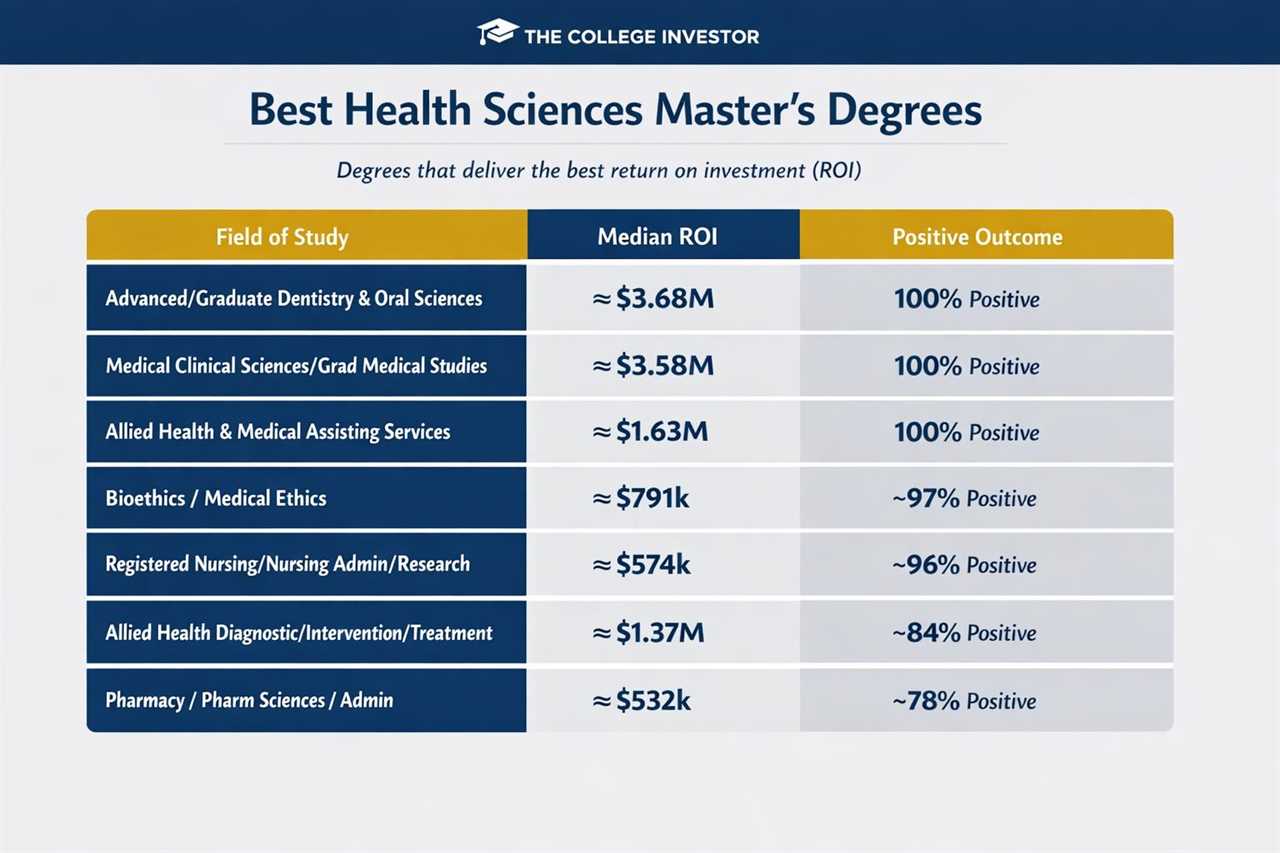
Fields with the strongest and most reliable ROI include:
- Advanced or Graduate Dentistry and Oral Sciences: Median ROI of $3.68M with 100% Positive Outcomes
- Medical Clinical Sciences and Graduate Medical Studies: Median ROI of $3.58M with 100% Positive Outcomes
- Allied Health Diagnostic, Intervention, and Treatment fields: Median ROI of $1.37M with 84% Positive Outcomes
- Registered Nursing, Nursing Administration, and Nursing Research: Median ROI of $574,000 with 96% Positive Outcomes
- Bioethics and Medical Ethics: Median ROI of $791,000 with 97% Positive Outcomes
These fields typically correspond to roles with well-defined credential requirements, predictable labor demand, and compensation structures that reward advanced training.
It's important to note that these are still good numbers if you have to borrow. Graduate nursing, with a median ROI of $574,000, still allows a student to borrow $100,000 in student loans and have it work out financially.
Which Fields Have The Worst Return
Other parts of the health science landscape look far more precarious. In several large fields, the median program leaves students underwater.
Consistently negative fields include:
- Alternative and Complementary Medicine: Median ROI of -$727,000 and 0% Positive Outcomes
- Mental and Social Health Services and Allied Professions: Median ROI of -$232,000 with only 11% Positive Outcomes
- Public Health: Median ROI of -$125,000 with only 25% Positive Outcomes
- Dietetics and Clinical Nutrition Services: Median ROI of -$65,000 with only 26% Positive Outcomes
These degrees often lead to roles with modest pay increases relative to bachelor’s-level work, while still requiring substantial tuition and foregone earnings. When you add student loan debt to the mix, the outcome can be even worse.
A negative median does not mean every program in a field is a bad investment. Even in public health, a small group of programs do post a positive ROI. And given that many of the jobs in these roles are public service, there is the component of Public Service Loan Forgiveness, which will forgive remaining student loan balances after 10 years.
The problem is reliability. In these fields, students cannot assume that the typical program will deliver a financial payoff. Outcomes depend heavily on institution, specialization, cost, and your end employment result.
School Type Matters
Institutional type shows a clear pattern:
- Public institutions: median ROI around $146,000, with about 65% positive.
- Private nonprofits: median ROI roughly $230,000, with 63% positive.
- Private for-profit institutions: median ROI about -$109,000, with only 43% positive.
Lower completion rates cluster heavily among large for-profit and online colleges, increasing the financial risk for students who borrow to attend.
How Borrowing Limit Changes Will Impact Students
Recent changes to federal student loan borrowing limits have sharpened the divide between professional degrees, which retain higher borrowing caps, and master’s programs, which do not. For health science students, that distinction is critical.
Many high-ROI health careers (dentistry, medicine, and some advanced clinical tracks) fall under professional degree frameworks. Lower-ROI master’s programs do not, even when they operate in adjacent health fields. These are considered graduate programs.
As a result, students pursuing degrees with weaker earnings upside now face tighter borrowing constraints and less margin for error. And for some programs, even full completion does not offset the cost.
Bottom Line
Health science master’s degrees are no longer uniformly safe financial bets. The same credential level can lead to outcomes ranging from multi-million-dollar gains to six-figure losses.
In a policy environment where borrowing limits are tighter and risk is increasingly shifted to students, program-level ROI analysis is becoming a basic consumer protection tool.
For students making six-figure education spending decisions, the data suggests that asking hard questions up front is no longer optional.
This analysis examines the return on investment (ROI) of 1,965 health science master’s degree programs using program-level data from the Foundation for Research on Equal Opportunity (FREOP) graduate degree ROI dataset. The goal is to measure the long-run financial value of completing a health science master’s degree, while explicitly accounting for tuition costs, foregone earnings, and the risk that a student does not complete the program.
Scope of Programs Included
Programs were limited to master’s-level degrees classified under the Health Professions and Related Clinical Sciences category (CIP Code 51). This includes 48 distinct fields spanning clinical, administrative, scientific, and alternative health disciplines. Fields range from registered nursing and allied health diagnostics to public health, dietetics, bioethics, and alternative and complementary medicine.
Earnings Measures
Two earnings benchmarks are used:
- Earnings at Graduation: Estimated median earnings during the first two years after degree completion.
- Earnings at Age 45: Estimated median earnings at mid-career, intended to capture long-run labor market outcomes rather than early-career volatility.
These earnings are compared to counterfactual earnings (what similar students would have earned had they not completed the graduate degree) to isolate the incremental value of the program.
Cost Measures
ROI calculations incorporate both direct and indirect costs of graduate education:
- Direct costs include tuition and required fees across all years of enrollment.
- Indirect costs include foregone earnings while enrolled, reflecting income students would likely have earned had they remained in the workforce.
Some ROI variants also adjust for underlying program costs before subsidies, providing a fuller picture of economic value independent of public funding.
Completion Risk
Estimated completion rates are derived from administrative data and vary across institutions and program types. Completion risk is central to the analysis: in this dataset, every program shows negative ROI in the event of non-completion, underscoring the financial consequences of dropping out.
Interpretation and Limitations
The results represent estimated financial outcomes, not guarantees for individual students. Earnings trajectories vary by geography, occupation, work intensity, and career path. The analysis also focuses on financial returns and does not capture non-monetary benefits such as job satisfaction or public service value.
Don't Miss These Other Stories:
Are MBAs Worth It In 2026? How Valuable Is Business School
Are MBAs Worth It In 2026? How Valuable Is Business School
Best Graduate School Student Loans And Rates
Best Graduate School Student Loans And Rates
5 Best Dental School Student Loans: Federal And Private
5 Best Dental School Student Loans: Federal And Private
The post Which Health Science Master’s Degrees Pay Off appeared first on The College Investor.
||
---------------------------
By: Robert Farrington
Title: Which Health Science Master’s Degrees Pay Off
Sourced From: thecollegeinvestor.com/74745/which-health-science-masters-degrees-pay-off/
Published Date: Thu, 12 Feb 2026 11:30:00 +0000
Read More
.png) InvestingStocksToolsClubsVideosPrivacy PolicyTerms And Conditions
InvestingStocksToolsClubsVideosPrivacy PolicyTerms And Conditions